

Blog
Digital Scale Buying Guide: Accuracy, Capacity, and Calibration

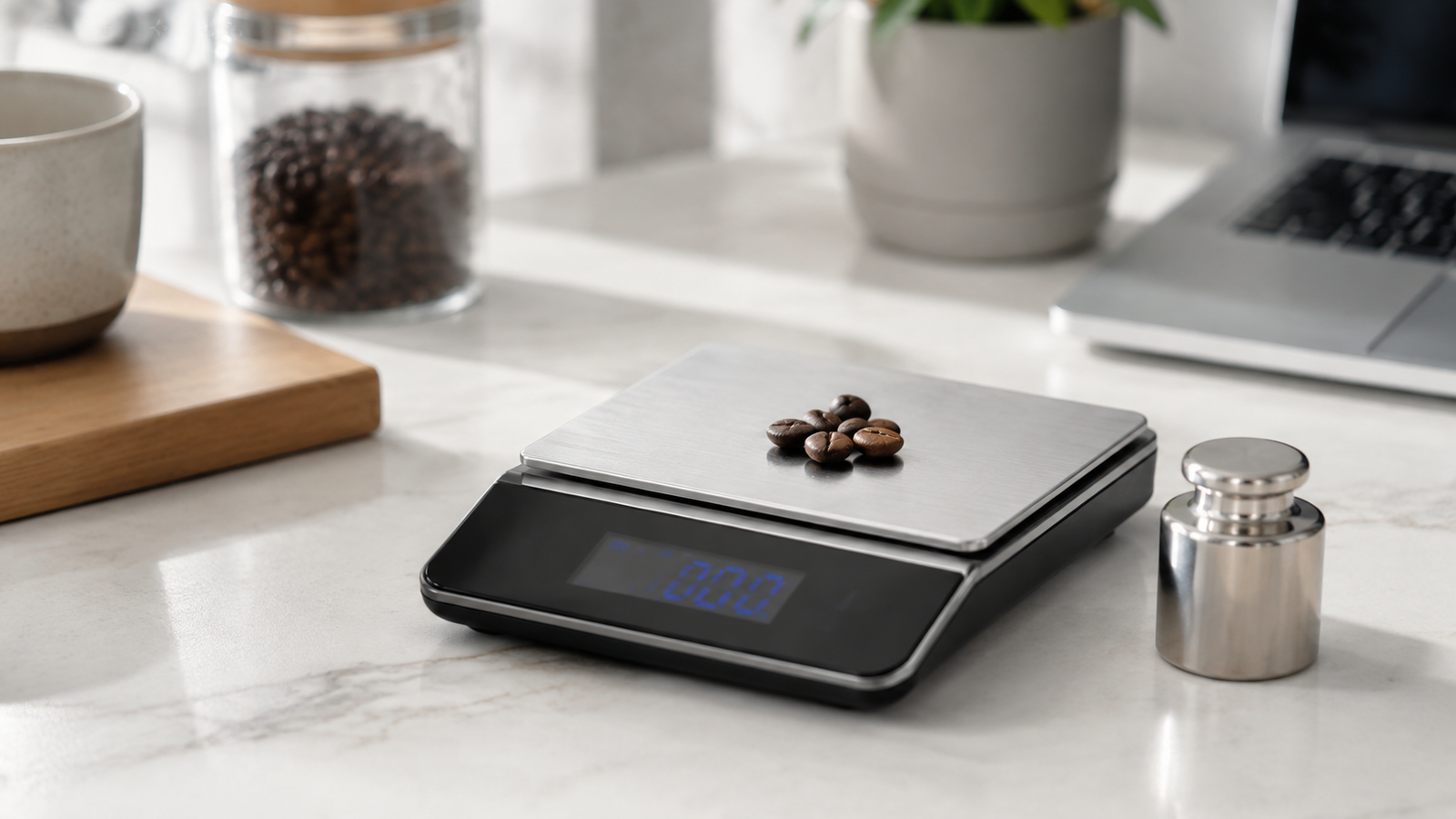
Digital scale listings often lead with two numbers: maximum capacity and display resolution. Those numbers are useful, but they do not tell the whole story. The right scale must also be repeatable, stable in the intended environment, large enough for the item, and supported by a practical calibration process.
Start with what you will weigh, the smallest meaningful change you need to see, and whether the result will be used for personal reference, quality control, shipping, or a commercial transaction.
Understand the Key Terms
| Term | What It Means |
| Capacity | The maximum load the scale is designed to weigh. |
| Readability or division | The smallest increment shown on the display, such as 1 g or 0.01 g. |
| Accuracy | How close a result is to the accepted value under stated conditions. |
| Repeatability | How closely repeated measurements of the same load agree. |
| Linearity | How consistently the scale performs across its weighing range. |
| Tare | A function that subtracts the container so the display shows net weight. |
A display with more decimal places does not automatically make a scale more accurate.
1. Match Capacity to the Heaviest Load
Estimate the heaviest item you expect to weigh, including any bowl, tray, or container. Choose enough headroom so routine loads do not sit at the maximum rating. Frequent overloading can damage the load cell or reduce long-term performance.
More capacity is not always better. A very high-capacity scale may offer coarser increments than a smaller precision model. If your work includes both heavy and very light items, two specialized scales may be more useful than one compromise.
2. Choose Useful Readability
Readability should reflect the smallest change that matters in your task. A kitchen scale may be practical at 1 g, coffee preparation may benefit from 0.1 g, and small jewelry or component work may require 0.01 g or finer. The correct choice depends on the process, not on the desire for the most decimal places.
Remember that readability is only the displayed increment. It does not prove accuracy or repeatability. Look for a published tolerance, test data, or calibration specification for the exact model.
3. Evaluate the Platform and Environment
- Platform size: the item should sit securely without covering the display or touching nearby surfaces.
- Drafts and airflow: fine-resolution scales can react to fans, open windows, air-conditioning, or breathing over the platform.
- Vibration: unstable tables, machinery, and footsteps can prevent a reading from settling.
- Level surface: use a firm, level support; some higher-grade scales include adjustable feet and a level indicator.
- Temperature: allow the scale and load to reach the operating environment, especially after storage or transport.
- Cleaning and materials: stainless platforms, removable trays, and sealed controls are useful where spills or powders are expected.
4. Check the Daily-Use Features
- Tare and zero controls should be easy to use and clearly separated.
- Units should match the task; confirm whether grams, ounces, pounds, carats, grains, or other units are needed.
- Stabilization speed matters when many items are weighed in sequence.
- Auto-off can save batteries but may interrupt long preparation or batching workflows.
- Counting, percentage, hold, and accumulation functions are valuable only when they match a real process.
- USB, Bluetooth, or serial output may be useful when results must be logged.
- Overload protection and a protective cover can extend service life in mobile or shared use.
5. Plan Calibration and Verification
Calibration compares and, where supported, adjusts the scale against a known reference weight. Some scales use an external calibration mass; others have an internal calibration mechanism. Confirm the required weight class and value before purchasing accessories.
Calibration frequency depends on the scale, usage, environment, and quality system. In addition to scheduled calibration, verify performance after transport, overload, a large temperature change, or any event that raises doubt. Store calibration weights clean and protected, and avoid touching precision weights with bare hands.
6. Know When “Legal for Trade” Matters
If the scale determines price, payment, a service fee, or another commercial transaction, ordinary consumer specifications may not be enough. In the United States, NIST advises buyers of commercial scales to look for an active National Type Evaluation Program Certificate of Conformance and to follow state inspection and approval requirements.
NIST also distinguishes the displayed scale division, d, from the verification scale division, e, used for accuracy class and tolerances. A smaller display increment does not necessarily mean better legal metrology performance.
| Commercial-use reminder: Confirm the laws and weights-and-measures requirements in the place where the scale will operate. Do not describe a product as “legal for trade” unless its certification and approval support that claim. |
A Practical Buying Checklist
- List the lightest and heaviest loads that matter.
- Choose a capacity with reasonable headroom.
- Select readability based on the smallest meaningful change.
- Confirm platform size, stabilization speed, and environmental suitability.
- Check tare, units, power, data, and cleaning requirements.
- Plan calibration weights, verification intervals, and recordkeeping.
- Verify commercial certification when results affect a transaction.
Bottom Line
Choose the lowest capacity and finest useful readability that comfortably cover the task, then confirm repeatability, platform size, calibration support, and environmental stability. For commercial use, compliance and local approval are part of the buying decision—not an upgrade to consider later.
| Suggested CTA: Explore digital scales by capacity, readability, platform size, and intended application. |